How AI-Driven Data Centers Are Reshaping Cooling Technology Demands
- Share
- publisher
- Boyi Cooling
- Issue Time
- Aug 26,2026
Summary
AI workloads are pushing data center rack densities past 15-40 kW, breaking traditional CRAC/CRAH cooling. Discover how dry cooler technology — closed-loop efficiency, free cooling, and modular scalability — is becoming the backbone of AI-ready thermal management. Market projected to reach $4.51B by 2035.
How AI-Driven Data Centers Are Reshaping Cooling Technology Demands
The artificial intelligence revolution is not just transforming software and data processing — it is fundamentally rewriting the thermal engineering requirements of the data centers that power it. As organizations deploy large language models, generative AI pipelines, and real-time inference clusters at unprecedented scale, the physical infrastructure supporting these workloads is being pushed to its thermal limits. Rack densities that once hovered around 5 to 10 kilowatts per rack are now surging past 15, 20, and even 40 kilowatts as GPU-accelerated servers become the standard rather than the exception. This shift is forcing facility operators, mechanical engineers, and equipment manufacturers to rethink every assumption about heat rejection, airflow management, and energy efficiency.
At Boyi Cooling, we have spent over two decades engineering dry cooler and heat exchanger systems for the most demanding industrial environments across more than thirty countries. The AI-driven density crisis is not a future projection — it is a present-day engineering challenge that our custom manufacturing capabilities are already addressing. This article examines why AI workloads break traditional cooling models, how dry cooler technology provides a scalable path forward, and what the market data tells us about the trajectory of this transformation through 2035.
The AI Heat Problem: GPUs Reshape the Thermal Landscape
To understand why AI-driven data centers demand fundamentally different cooling strategies, it helps to look at the hardware itself. A traditional CPU server rack might draw 5 to 10 kilowatts of electrical power, with most of that energy converted to heat that perimeter cooling units — CRACs (Computer Room Air Conditioning) and CRAHs (Computer Room Air Handling Units) — can manage through raised-floor or ducted air delivery. AI training and inference workloads tell a very different story.
Modern GPU clusters built around accelerators like the NVIDIA H100 and B200 series pack extraordinary computational density into each rack unit. A single H100 GPU can draw 700 watts or more under full load, and a fully populated training rack can easily exceed 40 kilowatts — four to eight times the heat load of a conventional CPU rack. Inference clusters, while individually less power-hungry, are deployed at massive scale to serve real-time AI requests, creating sustained high-density heat loads that run 24 hours a day, 7 days a week.
The problem is not merely the total heat load — it is the density of that heat. When 40 kilowatts are concentrated into a single rack, traditional hot-aisle/cold-aisle air containment strategies struggle to deliver enough cooling airflow to prevent localized overheating. Hot spots form, server inlet temperatures exceed ASHRAE recommendations, and thermal throttling degrades GPU performance precisely when training throughput matters most.
Why Traditional Data Center Cooling Cannot Keep Up
Conventional data center cooling architectures were designed for a world of 5 to 10 kilowatt racks. CRAC and CRAH units push chilled air through raised-floor plenums, and perforated floor tiles deliver that air to the cold aisle in front of each rack. This approach works reasonably well when each rack produces a manageable amount of heat and the air can absorb and transport that heat back to the return path efficiently.
At AI-scale densities, this model breaks down for several interconnected reasons:
- Airflow limitations: Moving enough air to cool a 40 kW rack requires enormous fan power and carefully managed containment. The energy consumed by CRAC fans and building HVAC systems can consume 30 to 40 percent of total facility power — a parasitic load that directly worsens PUE (Power Usage Effectiveness).
- Temperature delta constraints: Air has a low specific heat capacity compared to liquids. The temperature differential between supply air and return air is limited, meaning enormous air volumes are needed to extract the same heat that a modest liquid flow rate could handle.
- Hot spot formation: Even with containment, high-density racks create localized thermal events that perimeter air cooling cannot address quickly enough. GPUs throttle, training jobs slow, and in worst cases, hardware protection circuits shut down servers entirely.
- Scalability ceiling: Retrofitting additional CRAC units into an existing facility has a hard ceiling — there is only so much floor space, ductwork capacity, and chiller plant tonnage available. AI workloads can grow faster than the facility can add cooling capacity.
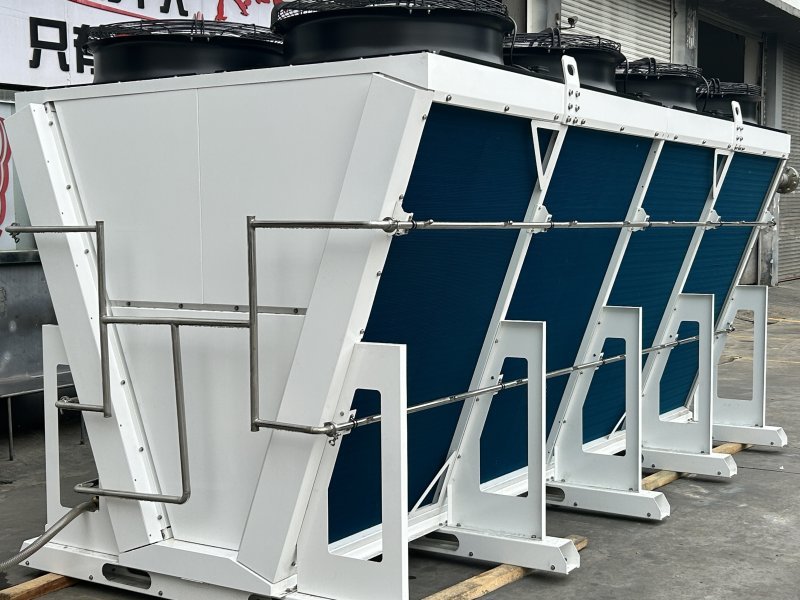
A high-capacity V-type dry cooler deployed for data center heat rejection — the modular, scalable architecture that AI-driven facilities increasingly rely on.
Dry Cooler Advantages for AI Workload Cooling
This is where dry cooler technology enters the conversation as a transformative solution rather than just an incremental improvement. Dry coolers — also called air-cooled heat exchangers or dry cooling coils — reject heat from a closed-loop fluid circuit to the ambient atmosphere using finned-tube heat exchanger coils and forced-air convection. No evaporative water is consumed in the primary heat rejection process. The process fluid (typically a glycol-water mixture) circulates in a sealed loop between the heat source and the dry cooler, absorbing heat at the server or rack level and releasing it to the outside air.
For AI-driven data centers, this architecture offers several structural advantages:
Closed-Loop Efficiency and Contamination Control
The closed-loop design means that the cooling fluid never contacts the outside environment. There is no evaporation, no drift, no blowdown, and no mineral scaling inside the heat exchanger coils. This is particularly important for AI data centers, which often house extremely expensive GPU hardware that cannot tolerate any risk of water ingress or airborne contamination. The sealed loop ensures that only clean, controlled fluid circulates through the server-level cooling plates or coil circuits.
Free Cooling Potential
One of the most compelling advantages of dry coolers for AI data centers is the ability to leverage free cooling — using naturally cold ambient air to reject heat without running energy-intensive chillers. In most temperate and cold climates, ambient air temperatures fall below the required process fluid temperature for thousands of hours per year. During these periods, the dry cooler can reject the full data center heat load using only fan power, with compressors completely off. For facilities running 24/7 AI training workloads, the annual energy savings from free cooling can reduce cooling-related electricity consumption by 30 to 70 percent depending on climate zone.
Scalability and Modular Deployment
AI workloads grow unpredictably. A research organization might add a new GPU cluster overnight, or a hyperscaler might expand a facility by megawatts in a single quarter. Dry coolers scale in a way that CRAC-based chiller plants cannot — additional dry cooler units can be deployed outdoors, connected to the existing loop, and commissioned in days rather than the months required for chiller plant expansion. This modularity aligns perfectly with the rapid scaling cycle of AI infrastructure.
Reduced Water Consumption
Traditional evaporative cooling towers consume significant volumes of water — a typical data center with cooling towers can use 1.8 liters of water per kilowatt-hour of IT load. In water-scarce regions where many AI data centers are being sited (due to land availability and renewable energy access), this consumption creates regulatory and sustainability challenges. Dry coolers reduce water usage for heat rejection by 95 percent or more compared to cooling tower-based systems, making them the preferred technology for ESG-conscious operators and regions with water stress.
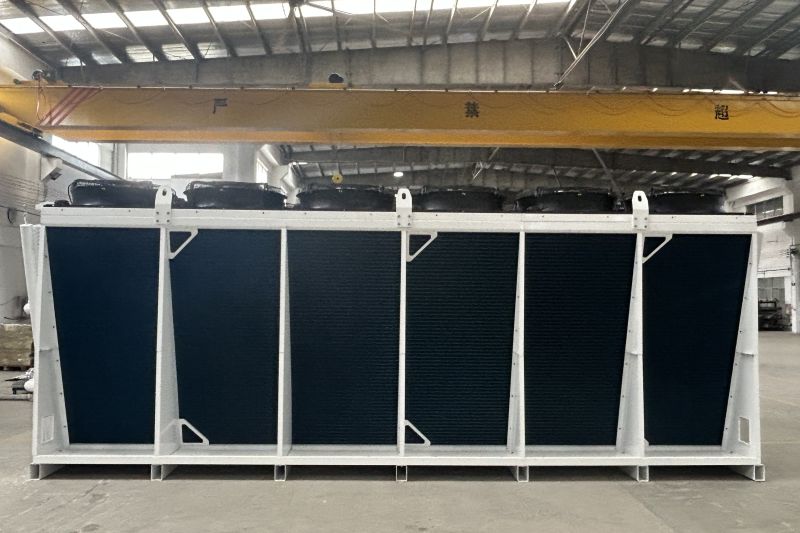
A 2500KW stainless steel tube V-type dry cooler — designed for high-density industrial and data center cooling applications where water-free heat rejection is essential.
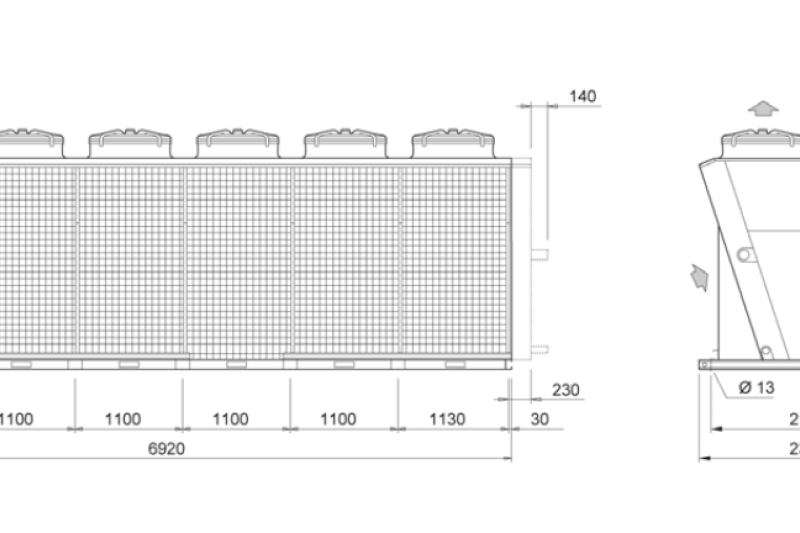
BOYI Customized 550KW Copper Tube V-type Dry Cooler for Data Center Cooling
A purpose-built 550-kilowatt V-type dry cooler engineered specifically for data center environments, featuring copper tube construction for superior heat transfer, modular V-frame architecture for efficient airflow, and closed-loop operation that eliminates water consumption while delivering reliable heat rejection for high-density AI and enterprise workloads.
View Product DetailsHybrid Cooling: Dry Coolers and Liquid Cooling for Extreme Density
For the most extreme AI training clusters — those operating at 50 to 100 kilowatts per rack and beyond — even direct-to-chip liquid cooling becomes necessary. In these scenarios, the optimal architecture is not dry-cooling-only or liquid-cooling-only, but a hybrid approach that leverages the strengths of each technology.
In a hybrid system, liquid cooling cold plates attached directly to GPUs and CPUs absorb heat at the chip level with extraordinary efficiency — a thin layer of conductive fluid can extract heat densities that would be impossible for air to handle. This primary heat absorption loop carries the process fluid to the heat rejection stage, where dry coolers serve as the final heat sink. The dry cooler rejects the accumulated heat to the atmosphere, completing the thermal cycle.
This architecture is particularly powerful because it decouples the two functions that traditional systems try to handle simultaneously. Liquid cooling handles the high-density heat absorption problem with maximum efficiency. Dry cooling handles the large-scale heat rejection problem with minimum energy, water, and maintenance overhead. Together, they create a system that can scale to multi-megawatt AI clusters without the parasitic energy and water costs of chiller-based alternatives.
| Cooling Architecture | Max Rack Density | Water Usage | PUE Potential | Scalability |
|---|---|---|---|---|
| Traditional CRAC/CRAH (Air) | ~10–15 kW | Moderate–High | 1.5–1.8 | Limited by chiller plant |
| Dry Cooler (Closed-Loop Fluid) | ~15–25 kW | Very Low | 1.2–1.4 | Modular, incremental |
| Hybrid (Liquid + Dry Cooler) | 50–100+ kW | Very Low | 1.1–1.25 | Highly modular |
| Cooling Tower (Evaporative) | ~15–25 kW | High | 1.3–1.5 | Moderate |
The hybrid approach is gaining rapid traction among hyperscalers and colocation providers who need to support both legacy air-cooled racks and next-generation liquid-cooled AI clusters within the same facility. By using dry coolers as the common heat rejection backbone, these facilities can serve diverse rack densities without duplicating cooling infrastructure.
Market Data: The Dry Cooler Data Center Boom
The market is responding to these technical realities with significant investment. According to industry research, the global dry cooler market for data center applications was valued at approximately $1.92 billion in 2025 and is projected to reach $4.51 billion by 2035, representing a compound annual growth rate driven primarily by AI and hyperscale demand. This growth reflects both new construction and retrofit projects as operators transition from evaporative and chiller-based systems to dry cooling architectures.
Several macro-level trends are fueling this expansion:
- AI workload growth: Training and inference workloads are projected to grow at 30–40 percent annually through 2030, driving continuous demand for additional cooling capacity at higher densities.
- Water regulation: Multiple U.S. states and EU jurisdictions are introducing water use restrictions for data centers, making water-free cooling a compliance requirement rather than just a preference.
- ESG mandates: Investors and tenants increasingly require verifiable sustainability metrics — PUE below 1.3, WUE (Water Usage Effectiveness) approaching zero — that dry coolers directly enable.
- Hyperscale expansion: Major cloud providers are building facilities in diverse climates, from Nordic free-cooling paradises to desert environments — each requiring customized dry cooler solutions.
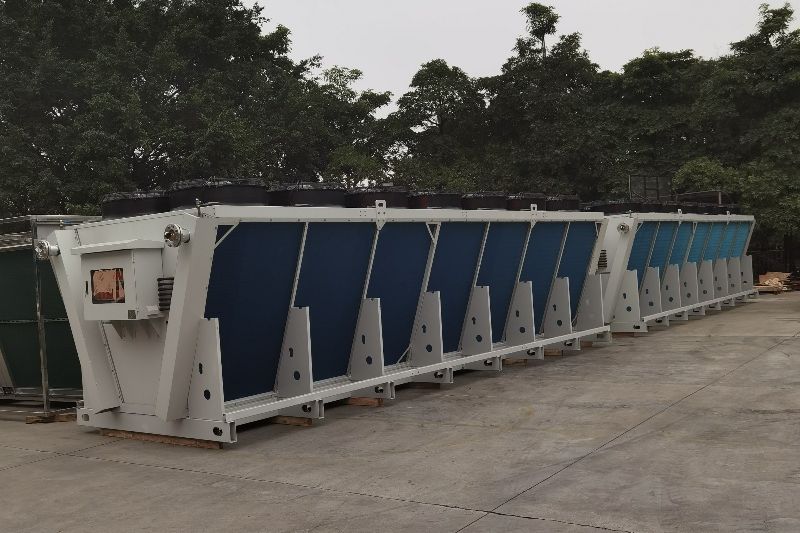
A 1000KW stainless steel tube dry cooler deployed at a high-density computing facility — the type of modular unit that AI data centers deploy in parallel arrays to scale heat rejection capacity.
Boyi Cooling's AI-Ready Solutions
As a manufacturer with over twenty years of thermal engineering experience and a track record of exporting to more than thirty countries, Boyi Cooling has positioned itself at the intersection of AI-driven demand and proven manufacturing capability. Our production facility designs and builds custom heat exchanger systems tailored to the specific thermal, spatial, and regulatory requirements of each project — no two AI data centers have identical cooling profiles, and our OEM/ODM approach ensures that every unit is optimized for its deployment context.
For AI data center applications, our portfolio includes several key product families:
2.5MW V-Type SS Dry Coolers
Stainless steel tube V-type dry coolers rated at 2.5 megawatts per unit — designed for the most demanding AI training clusters where corrosion resistance, thermal performance, and modular scalability are equally critical.
3.3MW Multi-Set Systems
Multiple 3.3MW stainless steel V-type dry cooler sets deployed in parallel for hyperscale facilities — each set independently controllable to match real-time load variations across diverse AI workload zones.
Hybrid Wet Curtain Systems
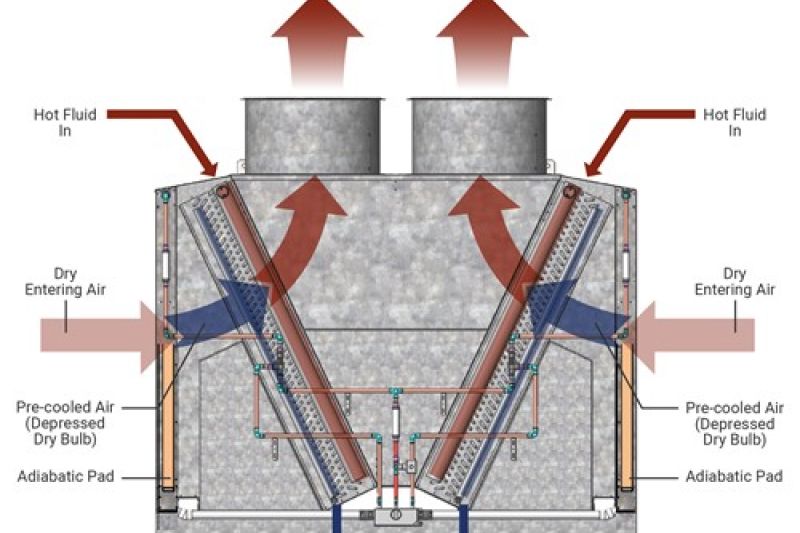
For facilities in hot climates where peak summer temperatures push dry-only cooling to its limits, our hybrid wet curtain augmentation provides adiabatic pre-cooling during extreme ambient conditions while maintaining near-zero water use during shoulder and winter seasons.
Every Boyi Cooling dry cooler is built with copper or stainless steel tube construction, aluminum fins optimized for the specific airflow and thermal duty requirements, and can be configured with variable-speed EC fans for intelligent load matching. Our engineering team works directly with data center operators, mechanical contractors, and design-build firms to size, configure, and commission systems that integrate seamlessly with existing BMS (Building Management System) infrastructure via Modbus or BACnet protocols. To discuss your specific AI cooling requirements, contact our engineering team or send an inquiry with your project specifications.
The Future: Edge AI, Modular Cooling, and Predictive Thermal Management
Looking beyond the current wave of hyperscale AI training clusters, several emerging trends will continue to reshape cooling technology demands through the rest of this decade.
Edge AI Inference and Distributed Cooling
Not all AI compute happens in massive centralized facilities. Edge inference — deploying smaller GPU clusters at telecommunications sites, urban data centers, and enterprise IT rooms closer to end users — is growing rapidly as real-time AI applications demand lower latency. These edge sites face unique cooling challenges: limited floor space, no raised-floor infrastructure, and often no access to chilled water plants. Compact, self-contained dry cooler units that can be deployed on rooftops or pad-mounted outdoors are becoming the default cooling solution for edge AI inference sites. Boyi Cooling's manufacturing flexibility allows us to produce compact heat exchanger units sized for edge deployments without sacrificing the thermal performance that high-density GPU racks require.
Modular and Prefabricated Cooling Plants
The industry is moving toward prefabricated, factory-tested cooling modules that can be trucked to site, connected to the facility's fluid loop, and commissioned in days. This approach reduces on-site construction risk, accelerates deployment timelines, and enables operators to add capacity in precise increments matched to actual workload growth. Dry coolers are inherently well-suited to this model — a complete V-type unit with fans, coils, controls, and fluid connections can be shipped as a single module and operational within hours of arrival.
Predictive Thermal Management with AI
In a fitting convergence, AI itself is becoming the tool that optimizes AI data center cooling. Machine learning models trained on historical thermal data, real-time workload patterns, and weather forecasts can predict heat load variations minutes to hours ahead, enabling proactive fan speed adjustments, free cooling mode transitions, and workload redistribution across cooling zones. This predictive approach can deliver an additional 10 to 20 percent energy savings on top of the baseline efficiency gains that dry coolers already provide — a compounding benefit that improves both PUE and operating cost.
Sustainability-Driven Design Evolution
As carbon disclosure requirements tighten and renewable energy penetration increases, the cooling system's energy profile becomes a critical factor in overall facility sustainability scoring. Dry coolers — with their low parasitic energy, zero water consumption, and ability to leverage free cooling — are positioned as a cornerstone technology for data centers targeting net-zero or carbon-neutral operations. Material innovation is also advancing, with stainless steel tube and fin configurations extending equipment lifespan beyond 50,000 operating hours and reducing the embodied carbon of replacement cycles. Learn more about our company's commitment to sustainable thermal engineering on our about us page.
Conclusion: Cooling Technology Must Match Compute Architecture
The AI revolution is not waiting for cooling technology to catch up — it is demanding that cooling technology evolve in parallel, and in many cases, lead the way. As GPU densities climb past 15, 25, and 40 kilowatts per rack, the era of CRAC-based air cooling as the default data center thermal strategy is drawing to a close. The future belongs to closed-loop, modular, water-efficient architectures that can scale incrementally, leverage free cooling, and integrate with both liquid cooling back-ends and intelligent BMS controls.
Dry cooler technology is not a niche alternative for this future — it is the backbone of the next generation of AI-ready data center thermal management. With the market projected to more than double by 2035, manufacturers that can deliver custom-engineered, certifiable, and globally deployable dry cooling systems will define the infrastructure layer of the AI economy.
Boyi Cooling's two decades of manufacturing experience, customized engineering capability, and global export footprint position us as a trusted partner for data center operators, design engineers, and OEM brand owners navigating this thermal transformation. Whether you are specifying cooling for a 500-kilowatt edge inference site or a multi-megawatt hyperscale training cluster, our engineering team is ready to design and build the dry cooler solution your workload demands. Start your project inquiry today and let our thermal engineers help you build cooling infrastructure that matches the scale and speed of your AI ambitions.