Electrophoretic Anti-Corrosion Treatment: How It Extends Heat Exchanger Lifespan
- Share
- publisher
- Boyi Cooling
- Issue Time
- Nov 6,2026
Summary
Corrosion, not mechanical failure, is what retires most finned-tube coils. This guide explains electrophoretic deposition (e-coating) for heat exchangers: how charged resin particles are driven onto the whole coil, why cathodic epoxy outperforms spray and dip, what ASTM B117 salt spray hours really prove, and when the coating premium pays back. Includes a coating comparison table, a Boyi Cooling electrophoretic condenser case and a four-point specification checklist.
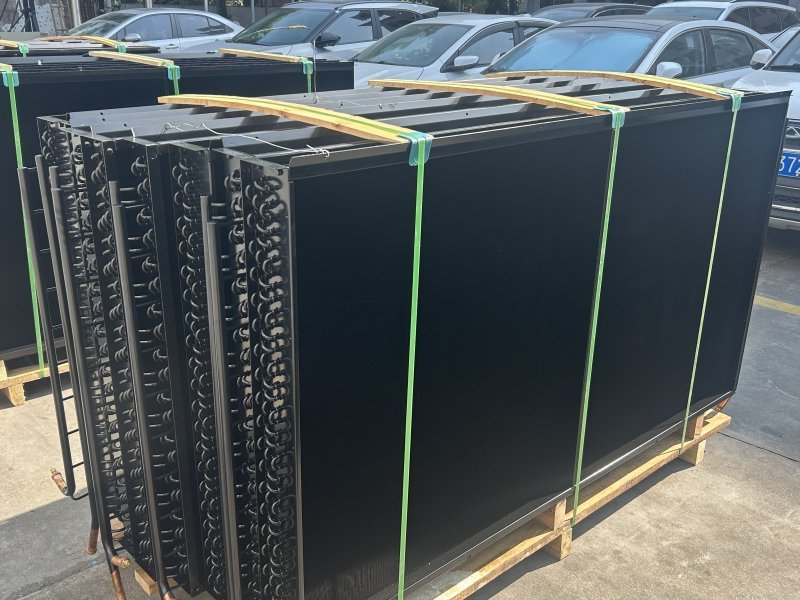
A heat exchanger rarely fails because its tubes burst. It fails because a few tenths of a millimetre of aluminium fin turns into white powder, the fin-to-tube bond breaks down, and the coil rated at 400 kW delivers 310 kW three summers later. Corrosion is the slowest, most expensive failure mode in cooling — and the one most often left out of the specification.
Electrophoretic coating — e-coating or EPD — changed that equation. Instead of spraying paint and hoping it reaches the gaps, it immerses the coil in a bath and uses current to deposit an even film on every conductive surface, including louvre interiors and fin-tube crevices. This guide covers the electrochemistry, what salt spray data really means, how it compares with spray, dip and GoldFin-type coatings, and when the premium is justified.
Quick Answer
Electrophoretic coating deposits a 15–35 µm epoxy film on a coil by immersing it in a paint bath under DC current, reaching surfaces a spray gun cannot. A sound cathodic e-coat typically delivers 1,000–3,000 hours of neutral salt spray to ASTM B117, against 200–500 hours for bare aluminium and 500–1,000 for epoxy spray — on coastal or chemical sites, the difference between a 10-year and a 15–20 year coil.
Why Corrosion Removes Coils From Service
Aluminium fin stock is chosen for conductivity and cost, but it is one of the more reactive metals in building services. In a dry inland plant room the natural oxide layer suffices. Add chloride from sea air or sulphur from a stack, and that layer is continuously stripped until the fin loses section. Four mechanisms dominate field failures:
- Galvanic corrosion. Copper tube and aluminium fin sit far apart on the galvanic series; any moisture bridge at the joint makes the aluminium the anode.
- Pitting. Chlorides breach the passive film at isolated points, so a fin can lose 40 percent of its thickness at one pit while looking acceptable overall.
- Crevice attack. Where a fin collar is expanded onto a tube, oxygen cannot replenish and the trapped chemistry turns acidic — precisely the region that sets the thermal bond.
- Formicary corrosion. Organic acids from insulation foams, sealants and cleaners attack copper from inside, leaving ant-nest tunnels.
The commercial effect is not a dramatic breakdown but a slow loss of capacity. Corroded fins add contact resistance at the tube joint, so a coil that has lost its bond across 20 percent of face area may shed 10–15 percent of heat rejection with no visible leak — owners then replace a coil that never leaked.
What Is Electrophoretic Deposition?
EPD is borrowed from automotive body protection. Charged resin particles sit in a water-borne bath, the coil becomes one electrode, and current drives the particles onto it as a film. Three stages follow, each shaping final performance.
1. Immersion
The assembly — tubes, fins, headers, connections — enters a bath of 10–20 percent solids. Full submersion removes any line-of-sight limit, so nothing hides behind headers or between close fins.
2. Electrodeposition
A DC potential of 100–300 V drives particles to the coil. The deposit is self-limiting: rising film resistance slows deposition, giving even thickness instead of a heavy build where the field is strongest.
3. Cure
The coil is rinsed, then baked at 160–180 °C so the resin cross-links. Cure control is critical: under-cured film stays soft and loses adhesion, over-cured film turns brittle and cracks in cycling.
Because deposition is electrically driven rather than sprayed, the film follows geometry: louvre interiors, header welds, return bends and the tight gaps between fins all receive close to the thickness of an external flat panel. That is the decisive difference from spray methods.
How the Process Behaves Inside a Finned Coil
Fin spacing of 1.8–2.5 mm and louvres folded several times per millimetre make the coil interior hostile to any coating method. A spray gun 200 mm from the face coats the first 20–30 mm and delivers less behind it; rear rows and louvre undersides stay bare.
EPD solves this through throwing power — the ability of the field to drive deposition into shielded areas. Bath and part conductivity govern it, since controlled solvent content keeps the field penetrating fin gaps instead of insulating itself off at the outer face, and a stepped voltage ramp lets film form gently in open areas first.
Cathodic Versus Anodic Deposition
Two chemistries exist and they behave differently enough that the variant belongs in the specification, not in the supplier's discretion.
| Parameter | Anodic e-coat | Cathodic e-coat |
|---|---|---|
| Coil polarity | Anode (positive) | Cathode (negative) |
| Film thickness | 15–25 µm | 20–35 µm |
| Salt spray | 500–1,000 h B117 | 1,000–3,000+ h B117 |
| Deposition risk | Metal dissolves at the part; ions contaminate the bath | Minimal substrate attack; stable bath chemistry |
| Typical duty | Light indoor, cost-sensitive | Coastal, chemical, food, process |
For a condenser or finned tube heat exchanger bound for a marine or industrial site, cathodic epoxy is the default: a thicker film and no substrate dissolution both convert into longer salt spray life. Anodic systems suit benign environments and tight budgets, but are not interchangeable.
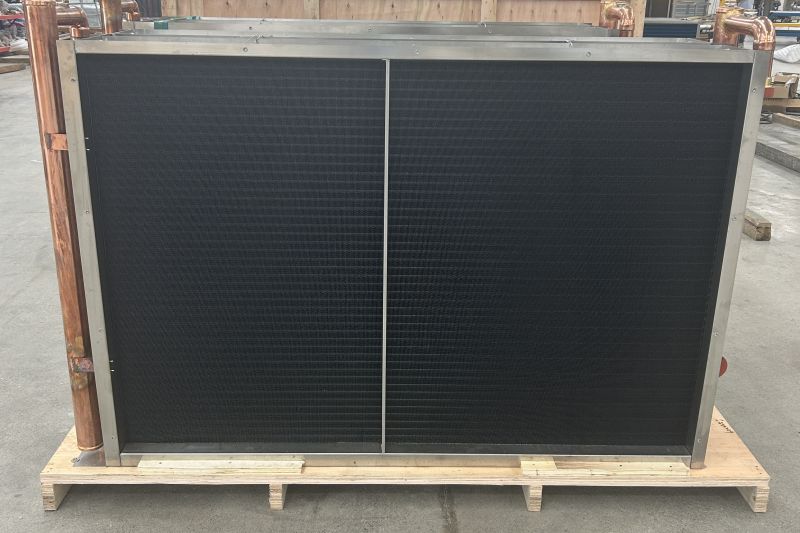
A coated fin block: the film must reach louvre interiors and fin-tube collars, not just the visible face.
Advantages Over Traditional Coatings
Uniform thickness
Self-limiting deposition holds ±5 µm across the whole coil, headers and return bends included. Spray varies from 20 µm at the face to under 5 µm in the rear rows.
Complete coverage
Every wetted surface is coated, including the fin collars where galvanic attack starts — the area sprays miss and the area that decides coil life.
No drips or pooling
No overspray, no runs at the bottom edge, no puddle blocking fin gaps. Pressure drop stays near bare-coil values instead of rising 10–20 percent.
Two costs keep the comparison honest. A 25 µm epoxy film conducts far less than aluminium, adding 1–3 percent capacity loss — negligible against the 10–15 percent lost to a corroded fin bond. And a bath, rectifier, oven and wastewater handling make e-coating a volume process, so a single replacement coil is usually better bought with quality spray coating.
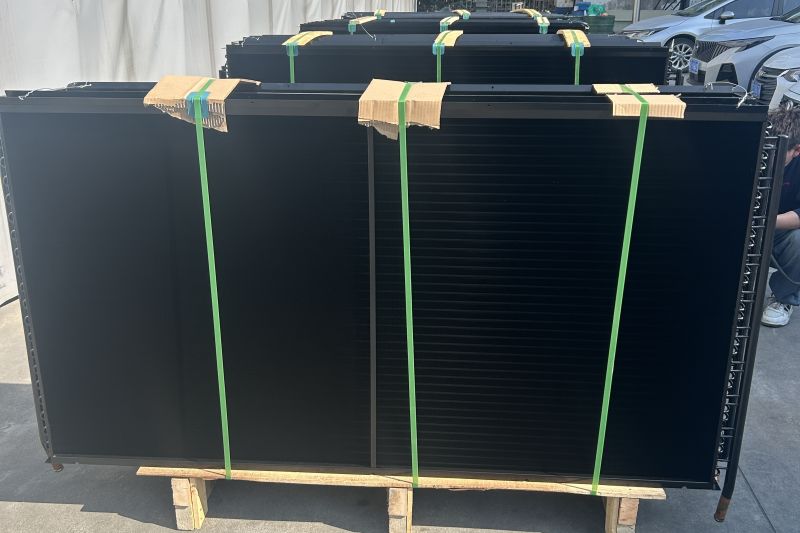
Reading Salt Spray Data Properly
The reference standard is neutral salt spray to ASTM B117, reported as hours to red rust or a defined corrosion level. It is a good comparative tool and a poor predictor of absolute life — both halves matter in a specification.
| Surface condition | Typical B117 | Realistic coastal service |
|---|---|---|
| Bare aluminium fin | 200–500 h | 5–8 years to measurable loss |
| Epoxy spray, single coat | 500–1,000 h | 8–12 years |
| Phenolic dip | 750–1,500 h | 10–14 years, brittle in cycling |
| Cathodic epoxy e-coat | 1,000–3,000+ h | 15–20+ years |
Three cautions apply. B117 is continuous fog, while a real coil sees wet-dry cycling, UV and cleaning, so hours do not convert linearly into years. Hours are meaningless without a stated end point — first blister, scribe creep beyond 2 mm, or first red rust. And salt fog says nothing about specific chemicals, so a chlor-alkali or pulp mill coil needs immersion data for the actual medium.
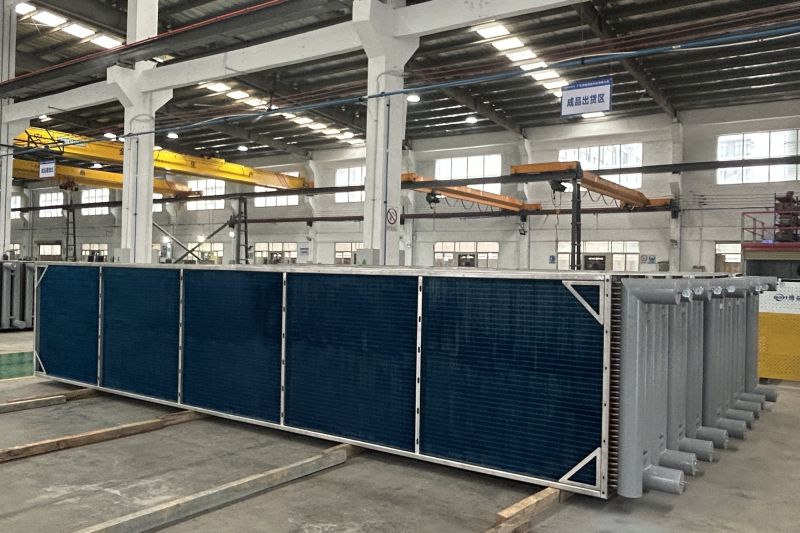
Process duty such as steel desiccation exposes coils to chemistry that salt fog alone cannot represent.
Field experience confirms the direction. On Gulf and Southeast Asian coastal sites, uncoated aluminium fins commonly show visible loss within four to six years and need replacement by year eight, while coils with a sound cathodic e-coat stay within 5 percent of nameplate at year twelve.
How It Compares With Other Coatings
E-coating is not automatically right; it sits at the top of both performance and cost, and alternatives win in specific situations.
| Coating | Fin-gap coverage | Flexibility | Cost index | Best fit |
|---|---|---|---|---|
| Bare / conversion coat | n/a | n/a | 1.0 | Dry indoor plant rooms |
| Epoxy spray | Poor behind front rows | Moderate | 1.3–1.6 | Short-life plant, retrofit repair |
| Phenolic dip | Good | Low, cracks | 1.5–1.8 | Chemical resistance, thicker film acceptable |
| GoldFin / hydrophilic | Fins good, tubes less | High | 1.4–1.7 | Condensate drainage, indoor humidity |
| Cathodic epoxy e-coat | Complete | High | 1.8–2.4 | Coastal, chemical, food, long-life assets |
GoldFin and hydrophilic films solve a different problem: condensate retention on evaporators, not chloride attack on condensers. Phenolic coatings resist chemicals but craze through 5–60 °C cycling. Epoxy spray is adequate in a dry inland data hall, where e-coat adds cost without adding life.
When to Specify Electrophoretic Coating
The decision follows the environment the coil will actually live in. Four situations justify the cost almost every time.
- Coastal and marine sites. Within roughly 5 km of the coast, or offshore, chloride deposition will consume a bare fin. The classic application, and where lifetime extension is most predictable.
- Chemical and process plants. Acid mist, alkaline dust and solvent vapour attack fin stock. E-coat is a continuous barrier, but the resin must be matched to the medium.
- Persistently wet duty. Adiabatic pre-cooling, food-plant washdown, any coil that stays wet — standing water plus oxygen drives crevice attack at the fin collar.
- Food, beverage and pharma. Humidity plus caustic and acid cleaning, and no tolerance for corrosion debris in the airstream. A hard, cleanable, low-VOC film meets both hygiene and documentation needs.
When E-Coating Is Not the Answer
Skip it for dry indoor plant rooms, sealed data halls with filtered air, and short-life installations. Reconsider it where coils see strong alkaline detergents or where field repair is likely: a damaged e-coat cannot be restored on site, and an unrepaired breach becomes a pitting site.
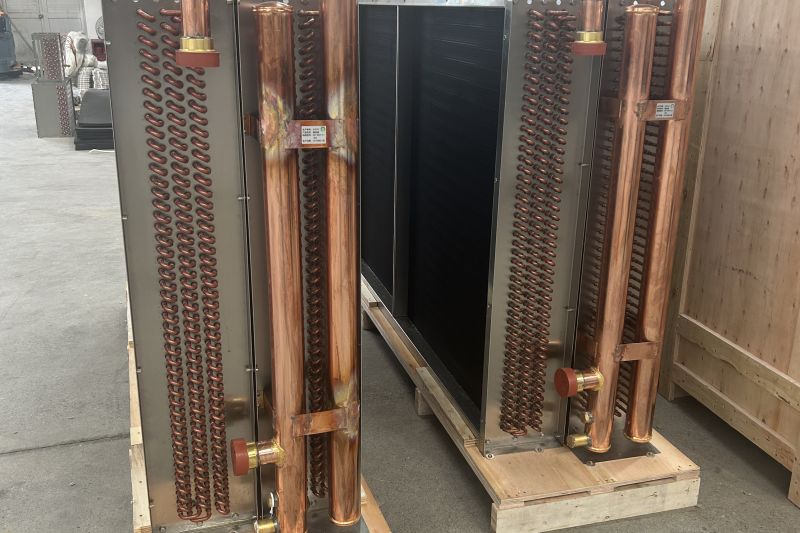
Boyi Cooling Case: Electrophoretic Anti-Corrosion Condenser
Boyi Cooling builds this condenser to order rather than as a catalogue item, because geometry, circuiting and coating all follow the duty. A representative coastal process unit:
| Parameter | Specification |
|---|---|
| Tube | Copper, Ø9.52 mm or Ø15.88 mm, per duty |
| Fin | Aluminium, louvred or flat, 1.8–2.5 mm spacing |
| Coating | Cathodic epoxy electrophoretic, 20–30 µm |
| Salt spray | 1,000 h minimum to ASTM B117, 2,000 h typical |
| Headers | Custom per drawing, flanged or plain |
| Testing | Hydrostatic at 1.5× design pressure before coating |
Sequence matters as much as materials: assemble, expand and pressure-test, then clean and phosphate, then coat, then cure. Coating first would hide leaks under the film. Boyi's custom heat exchanger manufacturing line handles the full sequence in-house, backed by 20+ years of thermal engineering and equipment in more than 30 countries.
Where the coating must be applied to a dry cooler or condenser already specified by the consultant, send drawing, duty and site conditions together. Send an inquiry with the chloride exposure class, and the coating specification can be matched to the application rather than defaulted.
Lifespan and Lifecycle Cost Impact
The usual claim is an extension from about 10 years to 15–20, and that range is credible. Take four condenser coils at USD 4,500 each, or USD 18,000 of capital. Uncoated, the realistic outcome is derating around year seven and replacement around year ten — say USD 20,000 with labour, rework and downtime. With a cathodic e-coat at a 40–60 percent coil premium, the same coils reach year fifteen, so a 20-year horizon avoids one full replacement cycle.
Capacity retained
An intact fin-tube bond keeps rated heat rejection instead of drifting 10–15 percent below nameplate.
Fewer unplanned stops
Coated coils degrade slowly rather than perforating at peak load.
Lower embodied impact
One fewer replacement per two decades means less copper, aluminium and refrigerant handling.
The maths only holds if the film survives installation. Two failures dominate: lifting damage from chains rather than a spreader beam, and solvent attack from an aggressive cleaner in year two.
Specification Checklist
A requirement written as "epoxy coated" gives a supplier almost unlimited latitude. Six items close that gap.
- Chemistry and polarity. State cathodic epoxy explicitly, not "electrophoretic".
- Film thickness. A range such as 20–30 µm, with a measurement method and sampling plan.
- Salt spray target and end point. Hours to a defined failure criterion, not hours to "failure".
- Pre-treatment and cure. Degrease and phosphate before deposition, then verify the bake with a solvent double-rub on a production coupon.
- Handling. Lifting method, touch-up material, and the damage limit beyond which a coil is rejected.
On a packaged unit the same logic extends to casing and fasteners: a coated coil in an uncoated galvanised frame merely relocates the corrosion problem.
Frequently Asked Questions
Does electrophoretic coating reduce coil capacity?
Marginally. A 20–30 µm epoxy film adds air-side resistance, and measured loss is generally 1–3 percent versus an identical bare coil — small against the 10–15 percent a corroded fin bond costs within a decade.
Can the coating be repaired on site if scratched?
Minor marks can be touched up with a compatible two-component epoxy. A breach inside the fin pack cannot be restored to the original standard, which is why handling procedure and protective wrapping matter as much as the coating.
Key Takeaways
- Corrosion removes capacity long before it leaks; the fin-tube bond is the first casualty.
- Electrodeposition is electrically driven, so it coats louvres, collars and rear rows that spray guns miss.
- Cathodic epoxy, not anodic, is the default for coastal, chemical and high-humidity duty.
- Salt spray hours are comparative, not predictive — ask for the standard and the end point.
- For dry indoor plant rooms, spray coatings deliver the same life for less money.
Need a Corrosion-Resistant Coil for a Demanding Site?
Boyi Cooling engineers custom finned-tube coils and dry coolers with cathodic electrophoretic coating for coastal, chemical, food and high-humidity duty. Send the duty, drawing and site conditions, and our thermal team will specify coil and coating together.
Talk to Our Engineers